(Download) JOHNSON IZUNNA – ”AM A MIRACLE” || @johnsonizunna

(Download) JOHNSON IZUNNA – ”AM A MIRACLE” || @johnsonizunna

Johnson Izunna (also known as Boi Zii) is a Dubai based Nigerian contemporary gospel singer, a songwriter and a music minister at Dominion City, Dubai.
He started his musical career in the secular sector before rediscovering his true calling and purpose, he then recorded his first gospel song in 2016 with a thanks giving song titled ”All About Love”.
His brand new single ”Am A Miracle” according to him, came from a heart of worship and gratitude, inspired by the holy spirit, taking us back at what Jesus did for us and is still doing, a spirit lifting song reminding us how free we are in Jesus Christ.

SONG LYRICS:
Ooowooh,you deserve all my praise saviour,say hallelujah..
Who would have believed it,when he said he’ll make a way were there’s no way.
Who would have believed it when he said he’ll make the laim to walk agaain [ooh] and who would have believed it that he paid a price for me and everyone yet he did it anyway..
My days of shame is over
My days of agony is over
My days of tears, days of pain,days of misery is over
And am no longer scared of temptations,am no longer scared of failures, and even if i battle i will never loose i will never give up no more…
AM A MIRACLE
AM A MIRACLE
MY LIFE IS A MIRACLE
THANK GOD FOR THE MIRACLE..
AM A MIRACLE
AM A MIRACLE
MY LIFE IS A MIRACLE
WITH JESUS IS POSSIBLE [3X CHORUS]
YOU ARE FULL OF MERCY
YOU ARE FULL OF LOVE
FULL OF COMPASSION
FULL OF GRACE [2X]
YOU NO DEY THROW ME AWAY
JESUS YOU NO DEY THROW ME AWAY
SAVIOUR YOU NO DEY THROW ME AWAY
[CHORUS 3X]
AM A MIRACLE
AM A MIRACLE
MY LIFE IS A MIRACLE
THANK GOD FOR THE MIRACLE
AM A MIRACLE
AM A MIRACLE
MY LIFE IS A MIRACLE
WITH JESUS IS POSSIBLE
AM A MIRACLE
AM A MIRACLE
MY LIFE IS A MIRACLE
THANK GOD FOR THE MIRACLE
AM A MIRACLE
AM A MIRACLE
MY LIFE IS A MIRACLE
WITH JESUS IS POSSIBLE.
[your days of shame is over..your days pain is over..your days of tears days of shame..they are all over].
Connect with Johnson Izunna
Twitter: @johnsonizunna
Instagram: @johnson_izunna

How Soon Will Jesus Return?

The “last days” began with the first coming of Jesus (Hebrews 1:2). From the time of Jesus’s ascension to the closing of the New Testament canon, the apostles believed Jesus’s return would be “soon” (Acts 1:10–11;Revelation 22:20). They lived with their eyes to the skies. And this belief informed the way they instructed the early Christians to live. For example, Paul says,
This is what I mean, brothers: the appointed time has grown very short. . . . For the present form of this world is passing away. (1 Corinthians 7:2931)
Now it’s been nearly two thousand years since Paul urgently put quill to papyrus and wrote those Spirit-inspired words. And here we are. The world has not yet passed away — but about a hundred human generations have. A “very short” time has turned out to be much longer than nearly everyone, except the Father, expected (Mark 13:32).
As a result, many of us struggle to feel the urgency Paul felt, and live like he instructed. How do we live in the last days that have lasted so long and may last for generations longer? The Bible addresses this question clearly so all Christians may know how to live without cynicism or apathy in these last days. We need to remember a few important truths.

Remember We Live in God-Time

The first truth to keep in mind is that God marks time differently than we do. Moses wrote, “A thousand years in your sight are but as yesterday when it is past, or as a watch in the night” (Psalm 90:4). And the apostle Peter wrote, “But do not overlook this one fact, beloved, that with the Lord one day is as a thousand years, and a thousand years as one day” (2 Peter 3:8). It’s only been two God-days since Jesus ascended and Paul wrote.
The better we know our Bibles, the more we grasp that the Ancient of Days’s soon is typically not our soon (Daniel 7:9;Revelation 22:7). What seems slow to us is not slow to God. Nothing in the New Testament demands that these last days be fewer than they’ve been.
Yes, many people have said and still say, “Where is the promise of his coming? For ever since the fathers fell asleep, all things are continuing as they were from the beginning of creation” (2 Peter 3:4). Here we are duly warned that Jesus’s return will seem ridiculously delayed — but he is not late.

Remember the Bridegroom’s Delay

Jesus himself warned us of this. First, he listed off some signs he said must take place before he returned:
  • An accrual of very compelling, powerful false prophets who lead many astray on a scale large enough to be recognized by the church everywhere (Matthew 24:4–51124–28);
  • A remarkable and frightening amount of natural and national calamities (Matthew 24:7–8);
  • An unprecedented level of persecution of Christians, along with an imminent threat of global human extinction (Matthew 24:21–22);
  • And the “gospel of the kingdom [would] be proclaimed throughout the whole world as a testimony to all nations” (Matthew 24:14).
Jesus said he would not return until these (and other) conditions are met. Which is why he told the parable of the ten virgins. Jesus described the bridegroom as being “delayed” — so delayed that the wedding attendants “became drowsy” (Matthew 25:5). In other words, Jesus wanted us to expect his coming to take longer than expected.
And it’s important to remember that the Bridegroom “delays” out of unsurpassed love for his bride. Hear his heart: “The Lord is not slow to fulfill his promise as some count slowness, but is patient toward you, not wishing that any should perish, but that all should reach repentance” (2 Peter 3:9). The Bridegroom will not allow a single person who is part of his Bride to be abandoned. His is a patient, purposeful, passionate procrastination.

Remember Life Is Short

If Jesus does not return during our lifetimes, we’re all going to meet him soon — sooner than we expect. Most of us will find this meeting as surprising as suddenly seeing him in the clouds.
Listen to this sampling of the Bible’s descriptions of our lifespans: “a breath” (Job 7:7); “a few handbreadths” (Psalm 39:5); “grass” that lasts a day (Psalm 90:5–6); “smoke” (Psalm 102:3); “a passing shadow” (Psalm 144:4); “a [vanishing] mist” (James 4:14). We do not know whether our souls will be required of us tonight (Luke 12:20) or whether we will live to see next year (James 4:13–14).
If Jesus’s return is not “very short” to us, our lifespans will be — whether we live to be twenty or ninety. In these last days — the world’s or ours — we need to pray often that God would “teach us to number our days that we may get a heart of wisdom” (Psalm 90:12).Our days are infected with evil and often consumed with “toil and trouble” (Psalm 90:10); we reallyneed God’s wisdom to spend what brief time we have on what reallymatters most (Ephesians 5:15–17).

Remember the Fig Leaves

Jesus told another parable to help us to watch the signs of the times with discerning eyes.
From the fig tree learn its lesson: as soon as its branch becomes tender and puts out its leaves, you know that summer is near. So also, when you see all these things, you know that he is near, at the very gates. (Matthew 24:32–33)
We may not know the day or the hour of Jesus’s return, but he expects us to watch for the signs he gave and discern them. He does not intend his coming to be a complete shock to us. He wants us to notice the changing of the leaves:
  • Have you noticed the proliferation of influential false prophets (not all religious)?
  • Have you noticed the scale of natural and national calamities over the past 120 years and the rising “fear and . . . foreboding of what is coming on the world” (Luke 21:25–26)?
  • Have you noticed the increasing levels of global hostility toward Christians as well as the increasing approval of the kinds of depravity Paul said would characterize people living in the last days (2 Timothy 3:1–5)?
  • Have you noticed the fresh reminders of the existent powers’ ability to eradicate humanity?
  • Have you noticed the unprecedented, nearly incredible advances of the gospel over the past 290 years — especially the past 120 years? There’s been nothing like the explosive growth of the Christian movement since 1900 in the history of religion — all the more amazing when we consider the ethnic, cultural, and geographical diversity of this growth.
Are you watching the leaves?

Watch, Pray, and Travel Light

“Be ready, for the Son of Man is coming at an hour you do not expect” (Matthew 24:44). Jesus meant for his return to feel potentially imminent in each generation, while also helping each generation anticipate his potential delay.
Jesus is coming back when the God-days are full, when the conditions are met, when his bride is ready, and when the summer leaves have reached their peak. It won’t be long before God’s soon is surprisingly soon to us. But even if we meet death before we meet the Lord in the air (1 Thessalonians 4:17), we will meet him soon.
Living the last days now is not really any different than it was for the first-generation Christians. We stay ready the same way they were to stay ready:
  • We watch the signs.
  • We pray for laborers to be sent into the harvest (Luke 10:2) — and say with Isaiah, “Here I am! Send me” (Isaiah 6:8) — and pray for the Lord to return (Revelation 22:20).
  • We encourage one another with our hope of resurrection and the Lord’s return (1 Thessalonians 4:13–18).
  • We travel light. We are exiles and sojourners here. We must not encumber ourselves with unnecessary baggage and treasures here because our real homeland and our real Treasure is up ahead (Matthew 6:19–20). And that’s where we want our hearts to be (Matthew 6:21).
Four thousand years ago, our ancestors in the faith began to live like “strangers and exiles on the earth” (Hebrews 11:13). That was two thousand years beforeJesus came and launched the last days. And we who live two thousand years after he came are no less strangers and exiles, because we too “desire a better country, that is, a heavenly one” (Hebrews 11:16). And we’re going to be there soon — sooner than we expect.

His Timing is Perfect

Let us then with confidence draw near to the throne of grace, that we may find grace for a well-timed help. (Hebrews 4:16, my literal translation)
I know this precious verse is usually translated, “Let us then with confidence draw near to the throne of grace, that we may receive mercy and find grace to help in time of need.” But that is a paraphrase — a true one — to show that God shows up just when we need him. But the literal focus is on how timely the help is.
All ministry is in the future — a moment away, or a month away, or a year, or a decade. We have ample time to fret about our inadequacy. When this happens, we must turn to prayer.
Prayer is the form of faith that connects us today with the grace that will make us adequate for tomorrow’s ministry. Timing really matters.
What if grace comes too early or comes too late? The traditional translation of Hebrews 4:16 does not make clear a very precious promise in this regard. We need a more literal rendering to see it. The promise is not merely that we find grace “to help in time of need,” but that the grace is well-timed by God.
The point is that prayer is the way to find future grace for a well-timed help. This grace of God always arrives from the “throne of grace” on time. The phrase “throne of grace” means that future grace comes from the King of the universe who sets the times by his own authority (Acts 1:7).
His timing is perfect, but it is rarely ours: “For a thousand years in [his] sight are but as yesterday when it is past” (Psalm 90:4). At the global level, he sets the times for nations to rise and fall (Acts 17:26). And at the personal level, “My times are in [his] hand” (Psalm 31:15).
When we wonder about the timing of future grace, we must think on the “throne of grace.” Nothing can hinder God’s plan to send grace when it will be best for us. Future grace is always well-timed.

When God’s Timing is Taking Too Long.

We all want good things to happen in our lives, but too often we want it now…not later. When it doesn’t happen that way, we are tempted to ask, “When, God, when?” Most of us need to grow in the area of trusting God instead of focusing on the “when” question. If you’re missing joy and peace, you’re not trusting God. If your mind feels worn out all the time, you’re not trusting God.
The tendency to want to know about everything that’s going on can be detrimental to your Christian walk. Sometimes knowing everything can be uncomfortable and can even hurt you. I spent a large part of my life being impatient, frustrated and disappointed because there were things I didn’t know. God had to teach me to leave things alone and quit feeling that I needed to know everything. I finally learned to trust the One who knows all things and accept that some questions may never be answered. We prove that we trust God when we refuse to worry.
God wants us to live by discernment—revelation knowledge, not head knowledge. It’s difficult to exercise discernment if you’re always trying to figure everything out. But when you’re willing to say, “God, I can’t figure this out, so I’m going to trust You to give me revelation that will set me free,” then you can be comfortable in spite of not knowing. Trusting God often requires not knowing how God is going to accomplish what needs to be done and not knowing when He will do it. We often say God is never late, but generally He isn’t early either. Why? Because He uses times of waiting to stretch our faith in Him and to bring about change and growth in our lives.

Wait with Patience

We spend a lot of time in our lives waiting because change is a process. Many people want change, but they don’t want to go through the waiting process. But the truth is, waiting is a given—we are going to wait. The question is, are we going to wait the wrong or right way? If we wait the wrong way, we’ll be miserable; but if we decide to wait God’s way, we can become patient and enjoy the wait. It takes practice, but as we let God help us in each situation, we develop patience, which is one of the most important Christian virtues. Patience is a fruit of the Spirit (see Galatians 5:22). It’s developed only under trial, so we must not run from difficult situations. But let endurance and steadfastness and patience have full play and do a thorough work, so that you may be [people] perfectly and fully developed [with no defects], lacking in nothing (James 1:4).
As we develop patience, the Bible says we finally feel completely satisfied—lacking nothing. Even our relationship with God involves progressive changes. My relationship with God is so much different now than it was in the early days of my Christian experience. It is not nearly as emotionally exciting…and yet it is better. Every change I’ve gone through has made me more mature, solid and well-grounded. We learn to trust God by going through many experiences that require trust. By seeing God’s faithfulness over and over, we let go of trusting ourselves, and gradually we place our trust in Him. Looking at it like this, it is easy to see how timing plays an important part in learning to trust God. If He did everything we asked for immediately, we would never grow and develop. Timing and trust work side by side.

Accept God’s Timing

God gives us hopes and dreams for certain things to happen in our lives, but He doesn’t always allow us to see the exact timing of His plan. Although frustrating, not knowing the exact timing is often what keeps us in the program. There are times when we might give up if we knew how long it was going to take, but when we accept God’s timing, we can learn to live in hope and enjoy our lives while God is working on our problems. We know that God’s plan for our lives is good, and when we entrust ourselves to Him, we can experience total peace and happiness.
The book of Genesis tells the story of Joseph, who waited many years for the fulfillment of the dream God had given him. He was falsely accused and imprisoned before the time came for him to do what God had shown him he was to do. Exodus 13:17-18 tells us that God led the Israelites the longer, harder way on their journey to the Promised Land because He knew they were not yet ready to go in. There had to be time for their training, and they had to go through some very trying situations. They wasted a lot of time wondering about God’s timing, but God never failed to take care of them and show them what He wanted them to do. The same is true in our lives. It was many years after I received my call from God in February of 1976 before I finally began to see major fulfillment of what God had called me to do. God’s training period simply requires us to do what He tells us to do when He tells us to do it…without questioning or trying to figure everything out.

Learn to Rely on God

Proverbs 16:9 says, A man’s mind plans his way, but the Lord directs his steps and makes them sureProverbs 20:24says, Man’s steps are ordered by the Lord. How then can a man understand his way? When God directs our paths, He sometimes leads us in ways that don’t make sense to us so we’re not always going to understand everything. If we try to reason out everything, we will experience struggle, confusion and misery—but there is a better way.Proverbs 3:5-6 Lean on, trust in, and be confident in the Lord with all your heart and mind and do not rely on your own insight or understanding. In all your ways know, recognize, and acknowledge Him, and He will direct and make straight and plain your paths. This sounds so simple, yet too many people make the mistake of trying to figure everything out themselves. Most of us have spent our lives trying to take care of ourselves, but when we accept Christ as our Savior, we must learn to trust our lives to His care. When we do, we can say with the psalmist, …I trusted in, relied on, and was confident in You, O Lord; I said, You are my God. My times are in Your hands…(Psalm 31:14-15).
First Peter 5:5 tells us that …God sets Himself against the proud (the insolent, the overbearing, the disdainful, the presumptuous, the boastful)—[and He opposes, frustrates, and defeats them], but gives grace (favor, blessing) to the humble. Anyone who thinks they’re a self-made man or woman has a rude awakening coming because Jesus said, …apart from Me [cut off from vital union with Me] you can do nothing (John 15:5). Humility is a covering that draws the help of God into our lives to protect us. When we humble ourselves by saying, “God, I don’t know what to do, but I’m trusting You,” God gets in gear to help us. God won’t allow us to succeed at anything unless we’re leaning and relying on Him. But when we humble ourselves under the mighty hand of God, in due time, He will exalt us (see 1 Peter 5:6). “Due time” is God’s time, when God knows we’re ready, not when we think we’re ready. The sooner we understand and accept that, the sooner God can work His plan in our lives.

From Seedtime to Harvest

Ecclesiastes 3:1 tells us: To everything there is a season, and a time for every matter or purpose under heaven. This lets us know that we all don’t live in the same season at the same time. You should never be jealous of someone who is enjoying harvest while you’re still in the planting season. Remember, they had to go through a season of planting just as you are. Seeing the results they are enjoying should be an encouragement to you. Understand and trust that God is doing the very best for you in your present season. Seedtime represents learning the will of God. Each time I choose God’s will instead of my own, I’m planting a good seed that will eventually bring a harvest in my life. If you want to be victorious, you cannot afford to get pulled into the world’s system, doing what you feel like doing. James 1:21 tells us what we should do: …get rid of all uncleanness and the rampant outgrowth of wickedness, and in a humble (gentle, modest) spirit receive and welcome the Word which implanted and rooted [in your hearts] contains the power to save your souls.
Your soul is your mind, your will and your emotions. When the Word gets rooted in there and begins to change your mind, it begins to heal your emotions and turn your will away from self-will and onto doing the will of God. Living out of one’s own soul is equivalent to staying in the wilderness. When my flesh is finally crucified, and I get out of my soul and into doing the will of God, that’s when I enter the promised land. The promised land is knowing who you are in Christ, knowing how to fellowship with Him, enjoying His presence, and having peace, contentment and joy. Between seedtime and harvest comes a time of waiting. After a seed is planted, the heat, moisture and pressure of the ground finally cause the outer hull to crack open. Then roots shoot down, digging their way through the ground. It takes time for this to happen, and it takes place underground. Above the ground, you can’t tell anything is happening. That’s the way our lives are. After we plant seeds of obedience, we feel like nothing is happening, but all kinds of things are happening inside where we can’t see. And like the seed that finally bursts through the ground with a beautiful green shoot, our seeds of obedience finally break forth into a beautiful manifestation of God in our lives.
When harvest time comes, the desires of your heart begin to manifest—bondages fall off of you and you see your dreams come to pass. You see your kids changing and your family getting saved.
Prosperity, favor, promotion, honor, and all kinds of good things come out in the open where they can be seen. In harvest time, more than ever before, you hear from God, you enjoy His presence, and you’re led by the Spirit. Blessings begin to chase you down the street, and joy and calm delight become your normal mood. Are you tired of waiting for harvest time in your life? Are you frustrated, crying out, “When, God, when?” Then you need to understand that God’s timing is often a mystery. He doesn’t do things on our timetable. Yet His Word promises that He will not be late, not one single day. But these things I plan won’t happen right away. Slowly, steadily, surely, the time approaches when the vision will be fulfilled. If it seems slow, do not despair, for these things will surely come to pass. Just be patient! They will not be overdue a single day!(Habakkuk 2:3).
God causes things to happen at exactly the right time! Your job is not to figure out when, but to make up your mind that you won’t give up until you cross the finish line and are living in the radical, outrageous blessings of God! The more you trust Jesus and keep your eyes focused on Him, the more life you’ll have. Trusting God brings life. Believing brings rest. So stop trying to figure everything out, and let God be God in your life.


Procrastination: A scientific Guide on how to stop Procrastination.

it becomes easier to avoid procrastination. One of the best ways to bring future rewards into the present moment is with a strategy known as temptation bundling.
Temptation bundling is a concept that came out of behavioral economics research performed by Katy Milkman at The University of Pennsylvania. Simply put, the strategy suggests that you bundle a behavior that is good for you in the long-run with a behavior that feels good in the short-run.
The basic format is: Only do [THING YOU LOVE] while doing [THING YOU PROCRASTINATE ON].
Here are a few common examples of temptation bundling:
  • Only listen to audiobooks or podcasts you love while exercising.
  • Only get a pedicure while processing overdue work emails.
  • Only watch your favorite show while ironing or doing household chores.
  • Only eat at your favorite restaurant when conducting your monthly meeting with a difficult colleague.
This article covers some specific exercises you can follow to figure out how to create temptation bundling ideas that work for you.

Option 2: Make the Consequences of Procrastination More Immediate

There are many ways to force you to pay the costs of procrastination sooner rather than later. For example, if you are exercising alone, skipping your workout next week won’t impact your life much at all. Your health won’t deteriorate immediately because you missed that one workout. The cost of procrastinating on exercise only becomes painful after weeks and months of lazy behavior. However, if you commit to working out with a friend at 7 a.m. next Monday, then the cost of skipping your workout becomes more immediate. Miss this one workout and you look like a jerk.
Another common strategy is to use a service like Stickk to place a bet. If you don’t do what you say you’ll do, then the money goes to a charity you hate. The idea here is to put some skin in the game and create a new consequence that happens if you don’t do the behavior right now.

Option 3: Design Your Future Actions

One of the favorite tools psychologists use to overcome procrastination is called a “commitment device.” Commitment devices can help you stop procrastinating by designing your future actions ahead of time.
For example, you can curb your future eating habits by purchasing food in individual packages rather than in the bulk size. You can stop wasting time on your phone by deleting games or social media apps. (You could alsoblock them on your computer.)
Similarly, you can reduce the likelihood of mindless channel surfing by hiding your TV in a closet and only taking it out on big game days. You can voluntarily ask to be added to the banned list at casinos and online gambling sites to prevent future gambling sprees. You can build an emergency fund by setting up an automatic transfer of funds to your savings account. These are all examples of commitment devices that help reduce the odds of procrastination.

Option 4: Make the Task More Achievable

As we have already covered, the friction that causes procrastination is usually centered around starting a behavior. Once you begin, it’s often less painful to keep working. This is one good reason to reduce the size of your habits because if your habits are small and easy to start, then you will be less likely to procrastinate.
One of my favorite ways to make habits easier is to useThe 2-Minute Rule, which states, “When you start a new habit, it should take less than two minutes to do.” The idea is to make it as easy as possible to get started and then trust that momentum will carry you further into the task after you begin. Once you start doing something, it’s easier to continue doing it. The 2–Minute Rule overcomes procrastination and laziness by making it so easy to start taking action that you can’t say no.
Another great way to make tasks more achievable is to break them down. For example, consider the remarkable productivity of the famous writer Anthony Trollope. He published 47 novels, 18 works of non-fiction, 12 short stories, 2 plays, and an assortment of articles and letters. How did he do it? Instead of measuring his progress based on the completion of chapters or books, Trollope measured his progress in 15-minute increments. He set a goal of 250 words every 15 minutes and he continued this pattern for three hours each day. This approach allowed him to enjoy feelings of satisfaction and accomplishment every 15 minutes while continuing to work on the large task of writing a book.
Making your tasks more achievable is important for two reasons.
  1. Small measures of progress help to maintain momentum over the long-run, which means you’re more likely to finish large tasks.
  2. The faster you complete a productive task, the more quickly your day develops an attitude of productivity and effectiveness. <a alt="See Footnote 3" class="footnote-button" data-footnote-content="

    Journalist Oliver Burkeman summarizes my thoughts by saying, “When I get straight down to something really important early in the morning, before checking email, before interruptions from others, it beneficially alters the feel of the whole day: once interruptions do arise, they’re never quite so problematic.”

    ” data-footnote-identifier=”3″ data-footnote-number=”3″ href=”https://jamesclear.com/procrastination#&#8221; name=”note-3-10871″ rel=”footnote” style=”backface-visibility: hidden; background-color: transparent !important; border-radius: 0px !important; border: none; box-sizing: border-box; color: #3a90ef; cursor: pointer; display: inline; font-family: inherit !important; height: 0.9em; line-height: 0; margin: 0px; min-height: 0px; min-width: 0px; opacity: 1; padding: 0px 0.2em 0px 0px; position: relative; text-decoration: none; top: -0.2em; transition: opacity 0.25s; vertical-align: middle; width: 1.78em; word-break: break-word; z-index: 5;” title=””>

I have found this second point, the speed with which you complete your first task of the day, to be of particular importance for overcoming procrastination and maintaining a high productive output day after day.

III. Being Consistent: How to Kick the Procrastination Habit

Alright, we’ve covered a variety of strategies for beating procrastination on a daily basis. Now, let’s discuss some ways to make productivity a long-term habit and prevent procrastination from creeping back into our lives.

[Download] Jekalyn Carr – I See Miracles

[Download] Jekalyn Carr – I See Miracles

Internationally acclaimed and award-winning artist/author/actress/speaker/entrepreneur Jekalyn Carr releases a brand new track titled “I See Miracles” to Gospel radio on today, her 22nd birthday.
The inspiration behind the song came from the interactions Jekalyn has shared with people from around the globe as she ministered. “During my visits to different cities, so many people would come to me, asking me to agree with them in prayer for what they were believing for
The track was produced and written with Jekalyn’s father, Allen Carr. The father/daughter duo come together again to present this inspirational and faith-activating song, “I See Miracles.” As a team, they have garnered three #1 Billboard Gospel singles at radio within the last three years – “You’re Bigger,” “You Will Win,” and “It’s Yours.” The label they operate – Lunjeal Music Group – became a 2018 Billboard Top 10 Gospel record label, along with Jekalyn being nominated for three GRAMMY Awards.

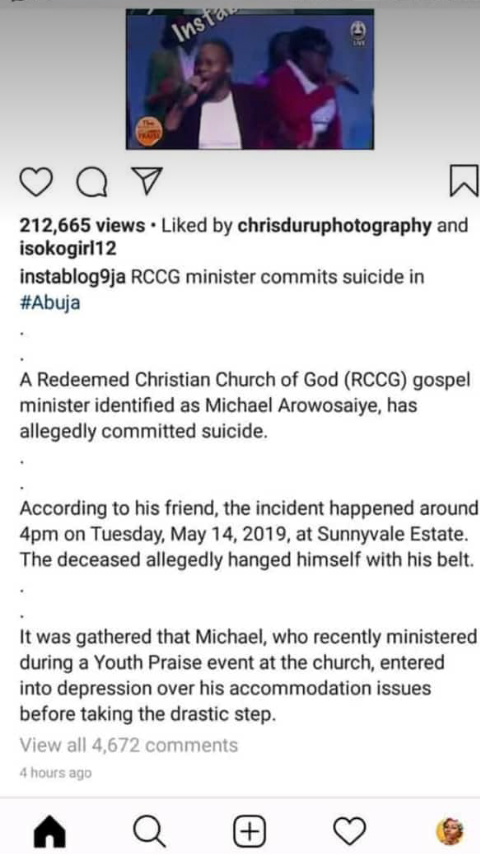
Shocker News!!! RCCG(Redeemed Christian Church Of God) Gospel music minister Allegedly commits sucide..

Shocker News!!! RCCG Gospel music minister Allegedly commits sucide..

RCCG Gospel music minister Commits suicide following his powerful ministration.

The minister who was identified as Micheal Arowosaiye committed suicide recently after ministering during a youth praise event at the church in Abuja. It was gathered that he went into depression over his accomodation issues before taking the drastic step on the 14th May 2019.

SAY NO TO SUICIDE.  Talk to someone today..

Design a site like this with WordPress.com
Get started